


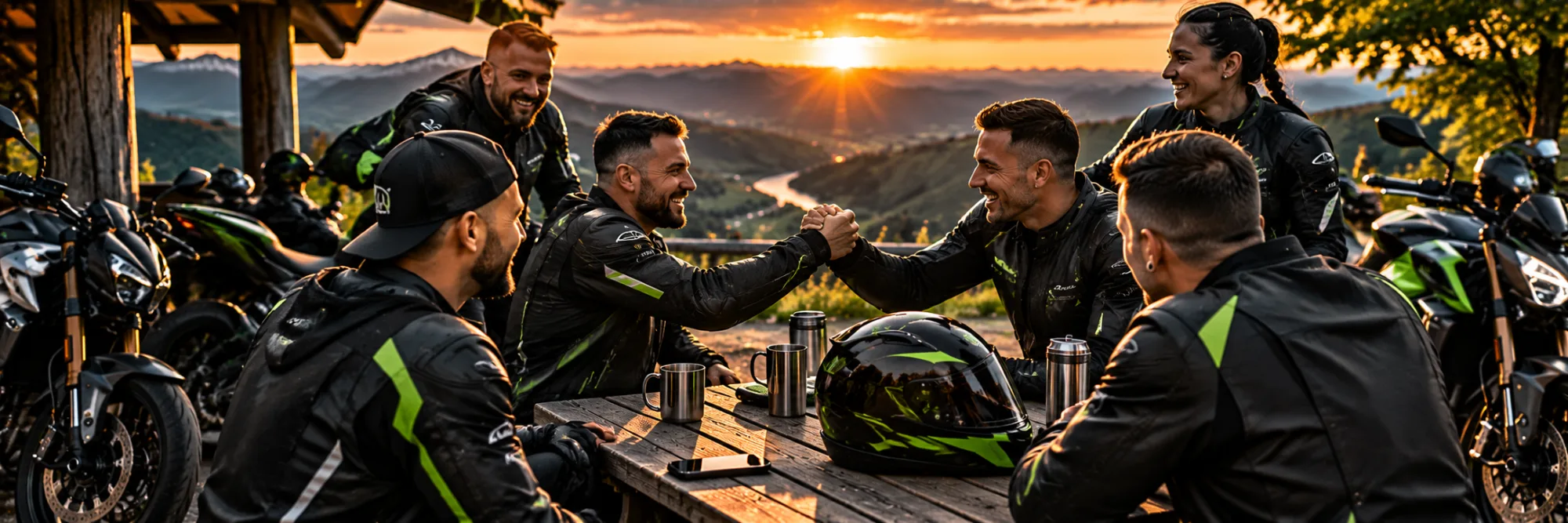
 AI-generated illustrative image
Why motorcycle groups are more than shared rides
Community, learning and responsibility on two wheels
Motorcycle groups are more than a meeting point for shared rides: they can offer guidance, pool experience and shape how riders treat each other. Whether it is a relaxed circle of friends, a regional regulars' meet-up or a formally organised club, what matters is not size but how respectfully, attentively and reliably the group behaves.
Motorcycle groups: on the road together, connected to each other
Riding a motorcycle is often a very personal experience. The helmet muffles the outside world, your concentration is on your line, the traffic and the road surface, and yet many riders are glad to share exactly this feeling with others. That is how groups form that reach far beyond the next coffee stop or the Sunday ride.
A group that works brings different people together: seasoned riders and returners, travellers and lovers of bends, riders with different motorcycles, paces and expectations. The shared interest is the starting point. It only becomes a real community through attentiveness, reliability and a willingness to give each other space.
A motorcycle group does not have to be permanently and formally organised. An open circle can also create community if agreements are respected and new people are welcome.
Belonging without pressure to conform
Many people look to motorcycle groups not just for riding companions, but for a sense of belonging. That can be especially valuable if hardly anyone around them shares the hobby. Nobody has to explain why a small country road, a wide view from a mountain pass or tinkering at the weekend means something. Shared experiences create a language that connects people quickly.
Good groups recognise that not everyone rides the same way or has the same goals. Some want to set off early and cover a lot of kilometres, others prefer short stages with time to talk. Some like carefully planned tours, others spontaneous destinations. Such differences do not have to lead to conflict. They become a problem when unspoken expectations are taken for granted.
Sustainable group culture
- Pace and breaks are discussed openly.
- Saying no to a tour or route is accepted.
- Different motorcycles and riding styles are considered normal.
- Experience is offered, not imposed.
Unhealthy group dynamics
- Riding along comes with pressure to perform.
- Uncertainty is met with smirks or comments.
- The fastest person always determines the tour.
- Different wishes are treated as a nuisance.
This does not mean that every group has to suit every person. A sport-oriented circle may be sport-oriented, a touring group may prefer longer daily stages. Clarity is what counts: if you know what you are getting into, you can consciously ride along, decline or look for a community that suits you better.
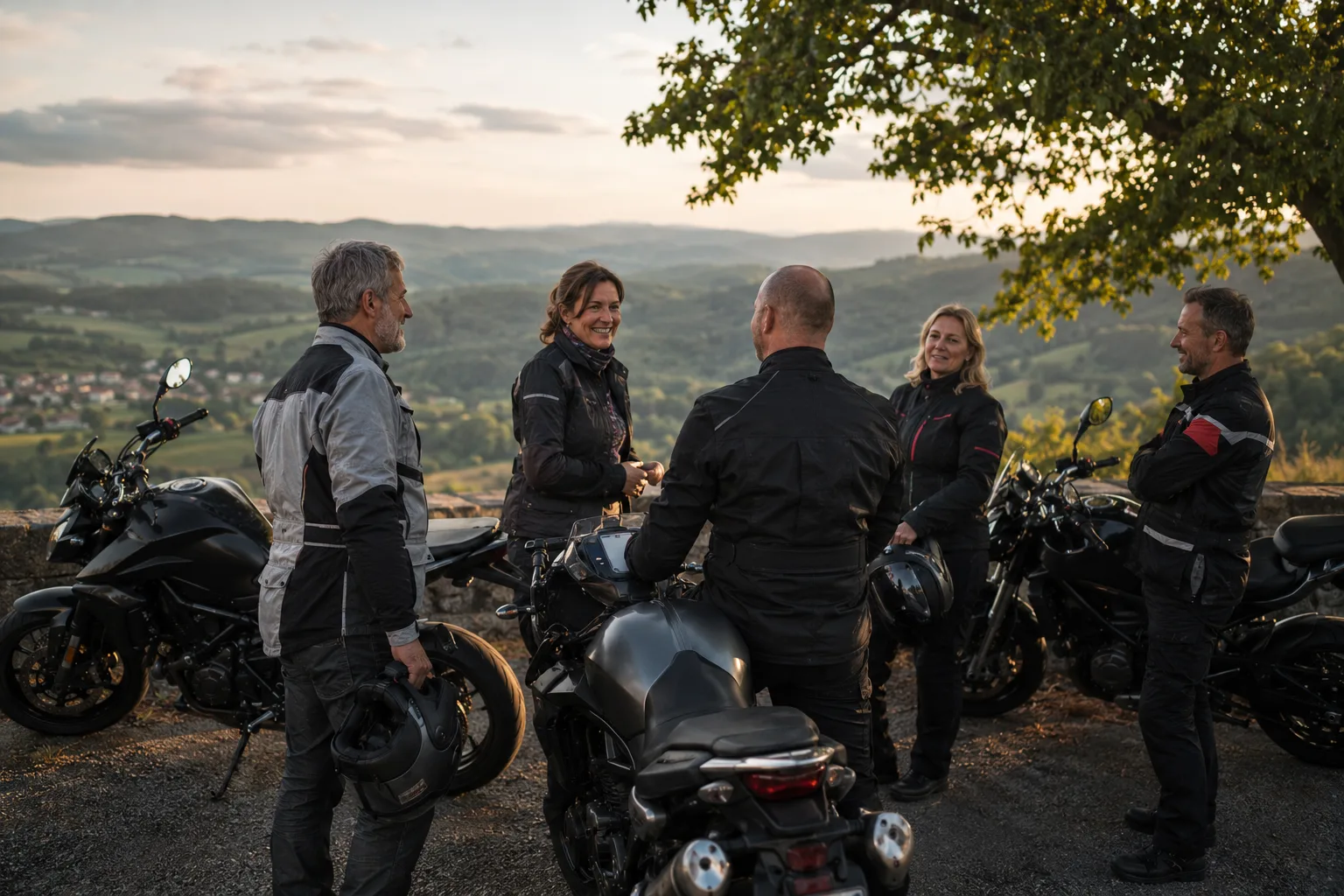 AI-generated illustrative image
Sharing experience without lecturing
One of the great benefits of groups is the exchange of experience. Anyone who has already planned many tours, ridden through rain or visited a particular destination can give practical advice. This ranges from ideas for breaks and luggage to conversations about riding technique, navigation or preparing the motorcycle. Such knowledge is especially helpful when it fits the specific situation and is put forward as an offer.
Less experienced riders in particular often benefit from seeing different approaches. At the same time, nobody should assume they can reliably judge another person's level of training, form on the day or the technical condition of another motorcycle from a distance. For questions about safety, health, legal requirements or repairs, qualified bodies and professionals are the better place to turn.
- Present experiences as personal observations rather than turning them into universal rules.
- Ask before giving unsolicited tips.
- Do not overload new group members with information.
- Treat mistakes and uncertainty as normal parts of learning.
- Keep good advice concrete: what happened, and what helped in that situation?
Long-time riders also keep learning in groups. Other motorcycle concepts, new tour ideas or a different view of breaks and routes can call routines into question. Staying open to this strengthens not only your own riding culture, but also respect within the group.
Group rides need clear, simple agreements
Out on the road, it becomes clear whether a loose arrangement is turning into a dependable group. A shared ride does not call for complicated rules, but a few easy-to-understand agreements help reduce misunderstandings. These include the meeting point, approximate duration, planned breaks, means of communication and a realistic description of the pace.
It is particularly important that nobody feels pushed into a pace that does not feel right for them. Each person remains responsible for their own riding and their own decisions. Anyone who needs more distance, wants to take a break or would like to skip a section should be able to do so without having to justify it. A group that takes this into account is usually not slower in any real sense; it is simply better organised.
- Before setting off, roughly agree on the meeting point, destination range and expected return.
- Be honest about the planned riding level and any more demanding sections.
- Agree on places to stop or a simple plan for when riders lose sight of each other.
- Exchange contact details only voluntarily and share as little as necessary.
- After the tour, briefly discuss what should go differently next time.
A group tour does not replace individual preparation. The condition of the motorcycle and gear, personal fitness to ride and planning suited to the route remain the responsibility of each individual.
What grows between the tours
The social core of a motorcycle group often shows not during the ride, but before and after it. Over a route idea in the chat, on a wrenching evening, at the regulars' meet-up or over a shared coffee, experiences get sorted out and contacts deepen. There can also be room here for topics that get short shrift on the road: travel plans, experiences with gear, route recommendations or the question of how to make a group more open.
Digital communities can be a useful addition to this exchange. They make it easier to find riding companions for a specific tour, gather questions and record feedback. If you want to dig deeper into topics around tours, preparation and getting along together, you will find more articles for guidance in the RideTree knowledge section. Online does not completely replace getting to know each other in person, though: trust develops above all through repeated, reliable encounters.
For many groups, small rituals are part of it too. That might be a season opener, a joint fundraiser, a regular breakfast before the tour or simply the habit of briefly checking after the return that everyone got home safely. Such gestures seem unspectacular, but they give a community structure and show that people are seen as more than just fellow riders.
Welcoming new people into the group fairly
For newcomers, the first contact with a motorcycle group can be both exciting and intimidating. Unclear insider rules, close-knit friendships or a seemingly uniform performance standard can make it harder to get started. Conversely, an established group knows little at first about what the new person expects. A short, open conversation before the first ride takes the pressure off both sides.
| Helpful for the group | Helpful for new riders |
|---|---|
| Describe the character of the tour and the meeting point clearly | Speak realistically about your own experience and wishes |
| Name a contact person for questions | Ask questions early rather than guessing on the road |
| Allow for breaks and a moderate way of getting to know each other | If unsure, choose your own pace |
| Do not expect permanent participation | Give honest feedback after the tour |
Openness does not mean anything goes. A group is allowed to protect its way of riding and treating each other. But it should make this culture understandable rather than silently taking it for granted. That way, new contacts can grow organically, and a one-off ride can turn into a lasting friendship.
The right group is not the same for everyone
Sometimes a group does not suit your own needs even though the people are likeable. Perhaps the dates are inconvenient, the routes too long, the communication too hectic or your interests diverge. That is not a personal failure. Motorcycle culture is diverse, and that is exactly why there is room for different forms of community.
If you are looking for a new group, you can start small: a manageable tour, an open meet-up or a coffee together often say more than big announcements. It matters less whether everyone shares the same brand, the same style of clothing or the same number of years in the saddle. What counts is a respectful tone, transparent expectations and the feeling that you do not have to prove your enjoyment of riding.
The best group ride is not necessarily the longest or the most spectacular. It is the one after which everyone involved would gladly set off together again.
Frequently asked questions about motorcycle groups
Do I need a lot of riding experience to join a motorcycle group?
No, many groups are open to different levels of experience. It helps to ask in advance about the pace, the character of the route and expectations, and to be honest about your own wishes.
How can I tell whether a group is right for me?
Pay attention to the communication before the first tour: are questions answered in a friendly way? Are the pace and the schedule clearly described? A short get-to-know-you meeting or a manageable ride can give you a good first impression.
What should be agreed before a group ride?
At the very least, it makes sense to cover the meeting point, the outline of the tour, breaks, a means of communication and a realistic estimate of the pace. The agreements should stay simple and be understandable for everyone.
Is it rude to leave a tour early while on the road?
No. If you do not feel comfortable, need a break or the tour does not suit your form on the day, clear feedback given as early as possible is appropriate. A responsible group respects this decision.