 AI-generated illustrative image
Motorcycling in autumn – watch out for leaves, wet roads and early darkness
How to adapt where you look, your speed, your following distance and your preparation to slippery roads, a low sun and short days.
It’s a poor idea to simply carry on riding in autumn as you would on a dry summer’s day and only brake once you see a pile of leaves. It makes more sense to approach autumn motorcycling differently from the very start of your ride: with margins for speed, following distance, where you look and time.
Motorcycling in autumn means factoring in the conditions
The most common misconception is that things only become dangerous once the road is obviously wet. In fact, many demanding spots occur precisely where the surface looks harmless at first. A shaded forest edge can stay damp for longer than the open road. Dirt can reach the carriageway from a driveway, and a thin layer of leaves hides edges, road markings or uneven patches.
Riding in autumn therefore doesn’t automatically mean cancelling every tour. Above all, it means adjusting your expectations. A sporty line through unfamiliar bends, late and hard braking points and big lean angles suit changing grip conditions less well. Anticipatory, flowing riding, on the other hand, gives you time, visibility and room to act.
Important: you can’t reliably ‘see’ grip while riding. The colour, sheen and texture of a patch offer clues, but no certainty. Ride so that an unexpectedly slippery section stays within your margins.
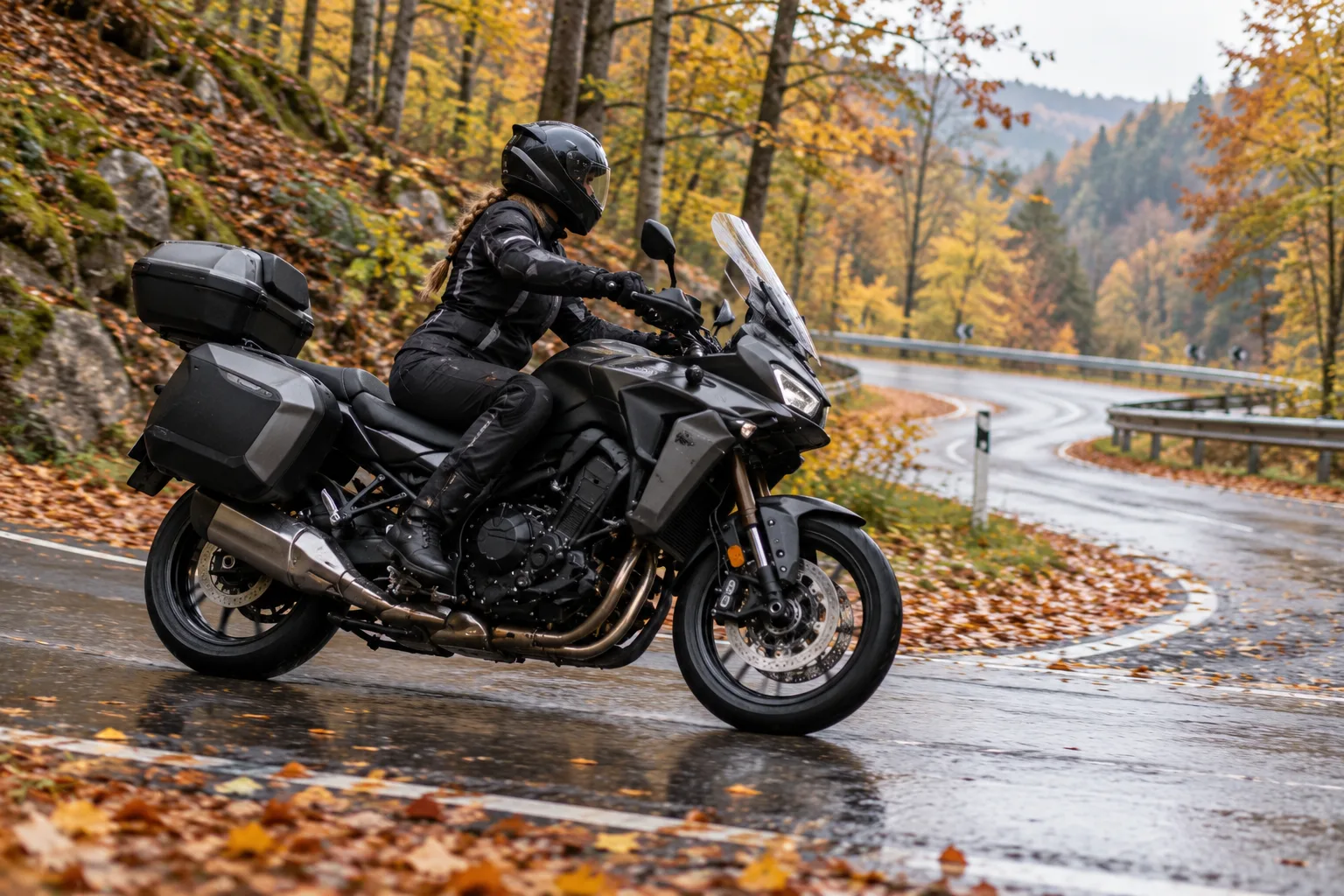 AI-generated illustrative image
Wet leaves: don’t test them, reduce the risk
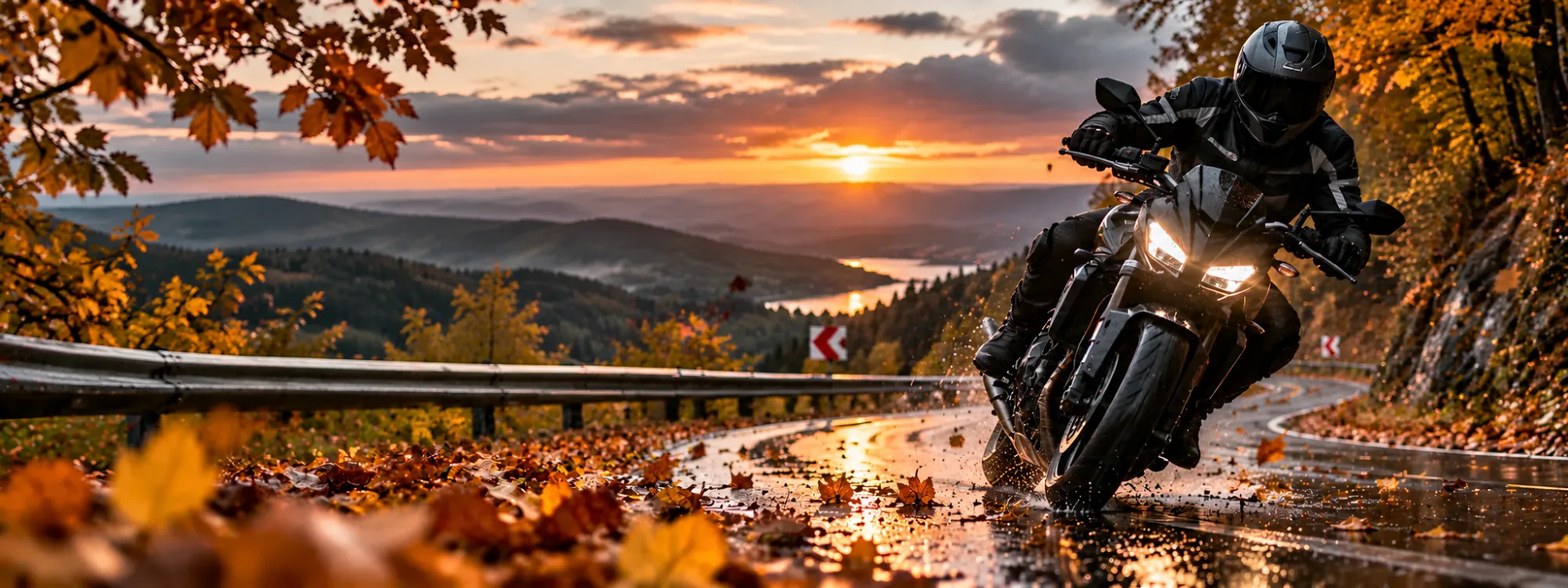
Dry, scattered leaves aren’t automatically a problem. Several layers can become critical, especially if they are damp, compacted or mixed with soil. The surface then resembles a smooth coating more than loose foliage. What makes it particularly awkward is that leaves can hide what the road is really doing: dirt, repair patches, manhole covers or the edge of the carriageway only become visible later.
If you can’t safely ride around an area of leaves, a simple line is usually the better choice: reduce your speed early, keep the motorcycle as upright as possible, steer loosely and calmly, and avoid abrupt changes in load. Braking, hard acceleration or hasty corrections while leaned over can make the situation worse. Where visibility allows, you should finish adjusting your speed before you reach the slippery area.
- On blind bends with leaves, always expect a slippery inside or outside edge.
- Don’t blindly trust the seemingly clean strip: the wheel tracks can be damp or dirty too.
- Deliberately keep your distance from the vehicle ahead and from the edge of the carriageway, where leaves, soil and water often collect.
- On a dense carpet of leaves, don’t force a hasty evasive move if there’s no clearly recognisable safe area to move into.
Wet conditions don’t change every road in the same way
Rain isn’t just rain. After a long dry spell, dust, tyre rubber and other residues on the road can make the first wet minutes particularly awkward. Persistent rain can wash away some of this contamination, but it brings puddles, spray and reduced visibility. Then there are local differences: under trees, in dips, on bridges or on north-facing slopes, conditions can be clearly different from those a few kilometres earlier.
| Situation | How you might recognise it | Sensible response |
|---|---|---|
| Forest edge or shaded area | Dark surface, damp, leaves | Slow down early and ride a calm line |
| Exit from a field or farmyard | Soil, leaves, damp tracks | Build in a braking margin and avoid big lean angles |
| Puddle or standing water | Reflections, unclear depth | Ride through straight and at a steady speed if you can’t go around it with a clear view |
| Bridge or crest | Temperature changes, damp, wind | Expect different grip and don’t wait until the highest point to react |
A bigger gap to the traffic ahead helps in two ways: it extends your reaction time and improves your view of the road surface. At the same time, your braking should stay predictable for those behind you. Use engine braking and the brakes in a measured way; how much makes sense depends on factors such as the motorcycle, load, tyres, road surface and riding situation.
Early darkness often begins before sunset
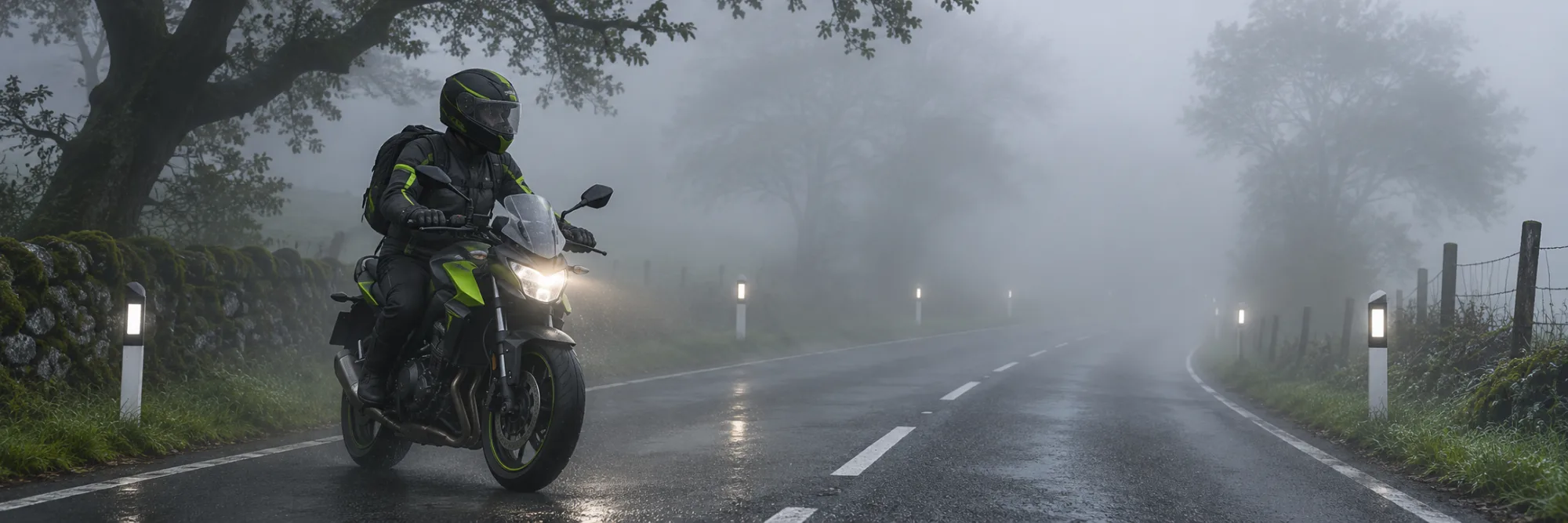
In autumn, usable visibility doesn’t only decrease once it’s completely dark. A low sun can dazzle you, alternating light and dark zones in the woods tire your eyes, and wet roads reflect headlight beams. A smeared visor intensifies these effects. Your own perception can also slow down when cold, wet and the effort of concentrating combine over a longer period.
So don’t plan your route right up to the last available minute. A familiar shortcut, an earlier break or ending your tour in good time aren’t a sacrifice, but sensible options. You’ll find further articles on route planning and other seasonal topics in our RideTree knowledge section.
Prepare your vision actively instead of improvising on the road
Before setting off, it’s worth taking a quick, objective look at everything that affects what you can see and how visible you are. A clean, undamaged visor matters just as much as working lights. Fogging on the inside shouldn’t only become an issue in a dark bend. The right anti-fog solution depends on your helmet, the weather and your personal comfort; the key thing is not having to try out how it works in a demanding riding situation.
Unhelpful habit
- Planning your route and return time as in high summer
- Reacting to an unfamiliar surface only just before the bend
- Treating a smeared visor as a minor detail
- Simply riding faster in the cold to arrive sooner
Better autumn practice
- Allowing spare time for breaks, detours and ending the tour earlier
- Reducing speed before spots with a poor view
- Checking visor and lights before setting off
- Stopping, warming up or shortening the tour when concentration fades
Cold: tyres, hands and concentration need time
Falling temperatures affect more than comfort. Cold hands can make precise control harder, and concentration often fades as you cool down. Tyres don’t work independently of temperature and riding conditions either. This doesn’t give you a general rule for a particular speed, but it does have a clear consequence: after setting off and after longer breaks, especially generous margins make sense.
Before longer rides, check your tyres according to the motorcycle or tyre manufacturer’s specifications, particularly their condition and pressure. Visible damage, a noticeable loss of pressure or an unclear tyre condition should be assessed by a professional. A quick function check of lights, brakes and controls doesn’t replace maintenance, but it can reveal obvious problems before you set off.
Warm, nimble hands and a clear head are part of your riding margin. If the cold impairs your control or tiredness increases, a break or ending the tour is often the better decision.
Before your autumn tour: check briefly, then set off consciously
- Realistically assess how the weather is developing, the daylight and your planned return time.
- Check your tyres for visible damage and correct condition according to the manufacturer’s specifications.
- Clean your visor and check that your lights work.
- If it may get cold, plan your clothing and breaks so that you stay mobile and focused.
- On the road, reduce your speed early as soon as leaves, shade, wet patches or poor visibility appear.
There are sensible exceptions to every general recommendation. A wide, clear and dry road doesn’t call for the same caution as a wet, leaf-covered bend in the woods. Conversely, a familiar local route can surprise you in autumn if the light, leaves and damp have changed. What matters isn’t a rigid recipe, but a willingness to adapt your riding to what is actually in front of you.
If you see this adjustment as a normal part of riding, you can consciously enjoy autumn tours: with a calmer rhythm, a more careful eye and enough margin for what can’t yet be seen beyond the next bend.