


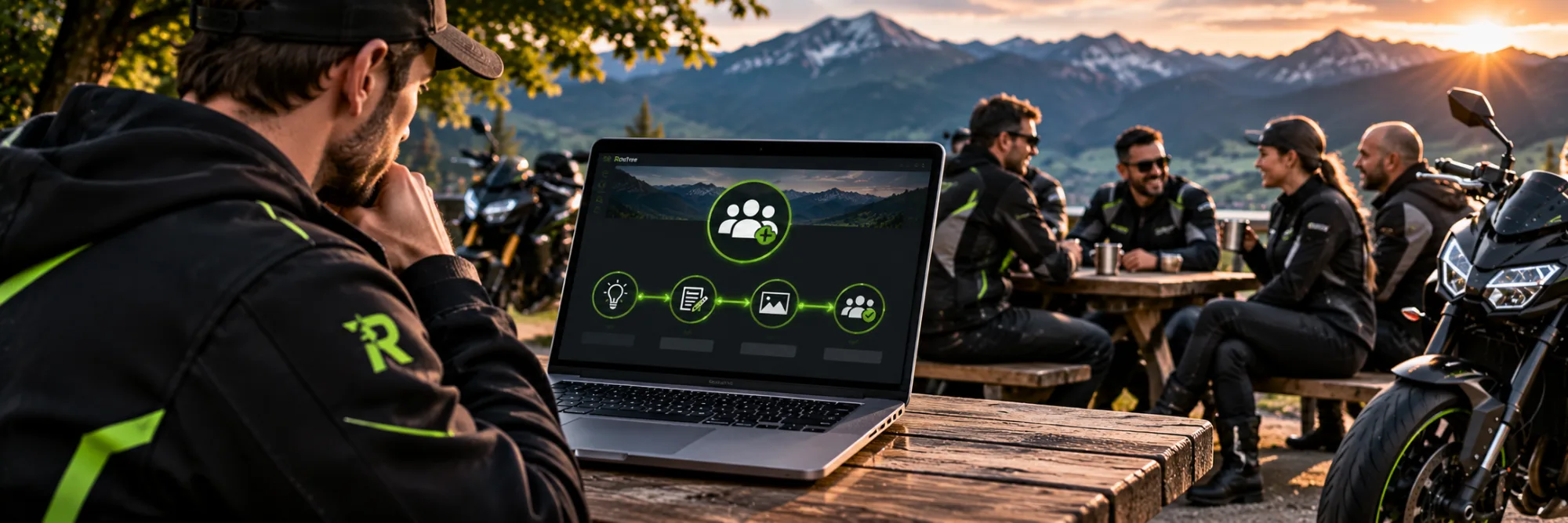
 AI-generated illustrative image
Founding a new RideTree group – from the idea to publication
How to turn a tour idea into a group with a clear purpose, suitable expectations and a good start.
Founding a RideTree group above all means quickly giving other riders orientation: what is it about, who fits in and what can members expect? With a clear description, realistic conditions and a good first occasion, an idea turns into an active community more easily than through the most general invitation possible.
Founding a RideTree group: not for everyone, but clearly the right fit
The most common misunderstanding: a good motorcycle group has to appeal to as many people as possible. In practice, though, a very open description often leads to queries and unsuitable expectations. "All welcome" may be meant kindly but answers neither the question of riding style nor of the regional connection or the type of joint activities.
A clear focus is no unnecessary restriction. It helps interested people decide and makes organisation easier for you. That could be an after-work ride in a particular region, relaxed country road riding, joint multi-day tours or discussions around a specific motorcycle topic. A group for beginners may also say so clearly – without deriving from it any promise about individual ability or safety.
 AI-generated illustrative image
Sharpening the group idea in a few sentences
Before you publish the group, a simple guiding question is worthwhile: what concrete reason does the group give people to join in? The answer doesn't have to be original. It should be understandable and honest. Anyone planning regular rides in the area may write exactly that. Anyone initially looking for like-minded people for occasional tours should not imply a fixed schedule.
- Region: Name a place, an area or a realistic catchment area.
- Activity: Describe whether tours, meetups, trip planning or discussion are the focus.
- Riding character: Word it carefully, such as "relaxed", "focused on bends" or "with regular breaks", instead of making rigid performance promises.
- Rhythm: Only state a frequency you are likely to be able to organise.
- Interaction: A short note on respectful communication and consideration sets a helpful tone.
A description that first names the purpose and then the process is helpful. For example: the group is aimed at riders from a particular region who want to plan relaxed weekend tours. Meetups, route length and pace are agreed in advance each time. This makes the core clear without anticipating too much of the later activities.
Making expectations visible without building a rulebook
On joint rides, different experience, motorcycles and daily form come together. A group cannot regulate this completely, but it can make expectations visible early on. This prevents misunderstandings better than long rules after the fact.
Unclear wording
- "We like to ride briskly."
- "Beginners are welcome."
- "Tours by arrangement."
Better orientation
- "We agree on the pace and breaks in the group before every tour."
- "New riders are welcome, provided that riding style and tour planning are discussed openly in advance."
- "Tour suggestions are announced with a meeting point, approximate time frame and requirements."
The limit of what a group description can do is important: it replaces neither a personal agreement before a ride nor a decision made on your own responsibility. Road conditions, weather, traffic and individual experience can differ. In tour announcements, details of the meeting point, planned breaks, approximate time frame and special route features are therefore often more helpful than a blanket pace label. You can also find further planning basics in the RideTree knowledge section.
Publishing with a small, concrete start
A group seems more credible if it is clear after publication how things will continue. This doesn't have to be a big opening event. An informal get-together, a date for joint season planning or a short regional ride may be enough. What matters is that the occasion suits the group described and is easy for new members to understand.
Keep the first event manageable. Smaller rounds make arrangements easier and give you a feel for which interests actually come together. As the group grows, feedback can lead to further formats: different tour lengths, seasonal meetups or conversations about travel plans. The original focus may develop but should remain understandable for members.
Don't wait to publish until every detail is settled. Purpose, region and a realistic next step are often enough for the start. Additions make more sense when they arise from concrete questions and activities of the members.
When a narrower or more open group makes sense
There is no ideal size or openness for every RideTree group. A close regional circle can make sense if regular spontaneous meetups are the priority. A more broadly defined group suits trip planning, cross-model discussion or infrequent joint events. A temporary group for a particular trip or season can also serve its purpose.
If the group develops differently than expected, adjusting the description is no failure. Change the framework openly and in good time. If you find, for example, that mainly longer day tours are happening, you can add this clearly. This keeps the group understandable for existing members and honestly classifiable for new interested people.
A quick check before publishing
- The group's purpose is clearly described in one or two sentences.
- Region, activity and rough riding or tour character are recognisable.
- The description promises only what can realistically be organised.
- Expectations for communication and arrangements are worded briefly and kindly.
- A sensible first occasion or next step is planned.